






Flying Alaska Airlines With Kids: A Real Stress-Test Guide for Families
Flying with your family already has enough moving parts. Add an airline’s fine print, and it’s easy to miss something small that turns into a big headache at the gate. This guide skips...


Flying with your family already has enough moving parts. Add an airline’s fine print, and it’s easy to miss something small that turns into a big headache at the gate. This guide skips the fluff and gets straight to the decisions you actually need to make — with two decision trees to help you sort them fast.
Table Of Content
Let’s start with the one that trips up almost every parent booking their first flight with a baby.
Do I need to add a lap infant to my Alaska ticket?
This is the single most common question new parents ask before their first flight. Here’s the short version: if your child is under 2 on the day you fly, they don’t need their own ticket — but they do need to be added to your reservation. Skipping this step is the mistake that causes real trouble at check-in.
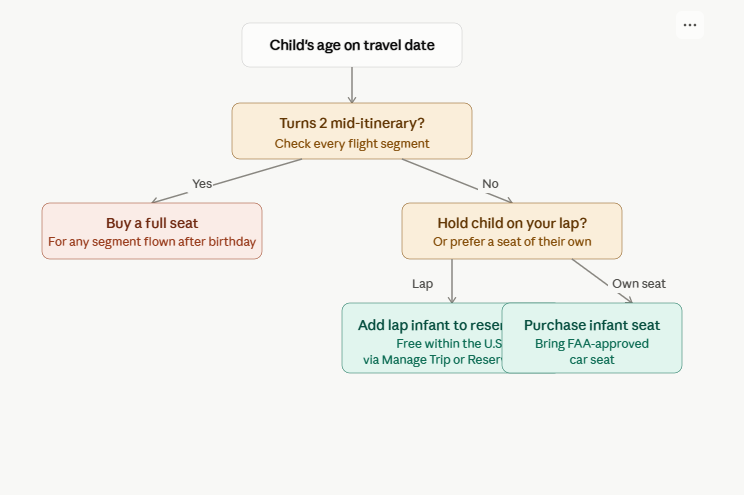
Here’s how that plays out in practice.
If your baby stays under 2 for the entire trip, you’ll add them as a lap infant right in your booking flow, or afterward through Manage Trip or by calling Reservations. Domestic lap infants fly free — no separate ticket cost. International itineraries are different: expect to pay around 10% of the adult fare plus taxes, and long-haul international lap infants must be ticketed through a live Reservations agent rather than online.
If your baby will turn 2 mid-trip — say, on the return leg — Alaska requires a full seat and a full-fare ticket for every segment flown on or after that birthday. This one catches people off guard on longer trips booked months in advance.
If you’d rather buy your infant their own seat, you can bring an FAA-approved car seat aboard. That seat should go by the window, since aisle seats and exit rows aren’t allowed for child restraints.
Common mistakes with lap infants — and how to avoid them
- Forgetting to add the infant at all. An unlisted infant can cause delays at the gate while agents sort out documentation. Add them the moment you book, not the week before.
- Assuming the diaper bag is a freebie. It isn’t. It counts against the carry-on limit of the adult holding the infant — lap infants get no carry-on allowance of their own.
- Not checking row restrictions. Only one lap infant is permitted per row, including both sides of the aisle, and the rule shifts slightly depending on the flight number range. If you’re traveling with another family and both have lap infants, confirm your seat assignments don’t land in the same row.
- Leaving age documentation at home. Alaska can request a birth certificate or passport at any point to confirm your child hasn’t crossed the 2-year line. Keep it in your carry-on, not checked luggage.
Getting your name right before you fly
The second thing that quietly derails family trips: a name on the ticket that doesn’t match ID. This becomes a bigger issue with kids in the mix, because you’re managing several names at once, and it’s easy for one to get fat-fingered during a rushed booking.
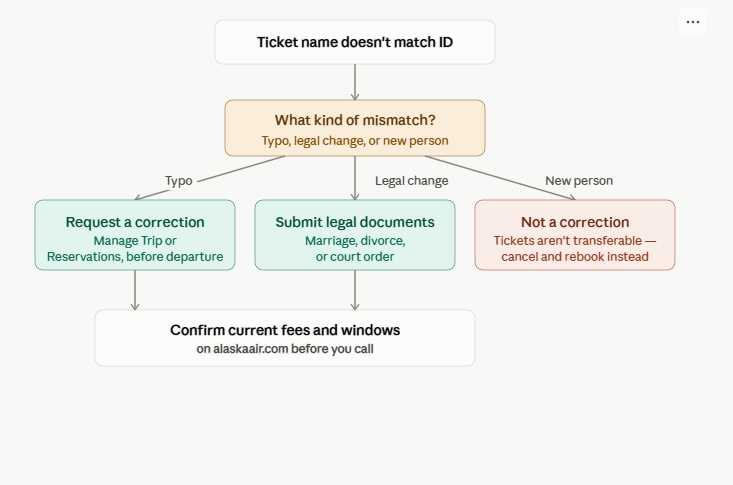
Here’s the nuance most guides skip: Alaska treats these three situations differently, and knowing which one you’re in saves you a wasted phone call.
Simple spelling errors — a transposed letter, a missing initial, a dropped hyphen — are the easiest fix. These are handled through Manage Trip online or by phone with Reservations, and it’s worth doing as soon as you spot the error rather than waiting until the day of travel.
Legal name changes, like a name that changed through marriage, divorce, or a court order, need supporting documentation. Have that ready before you call so the agent can process it in one pass instead of two.
Full name transfers — putting someone else’s name on your ticket — aren’t corrections at all under the Alaska Airlines name correction policy. Tickets are tied to the original traveler and generally aren’t transferable to a different person. If you booked for the wrong family member entirely, you’re usually looking at canceling and rebooking rather than “correcting” your way out of it.
Because fees, character limits, and processing windows on airline policies shift over time, don’t rely on secondhand blog posts (including this one) for exact dollar amounts. Confirm the current terms directly on Alaska Airlines’ name correction and transfer page before you call in.
Common name-mistake mistakes
- Waiting until 24 hours before departure. Corrections close to departure are handled with less flexibility. Fix errors the moment you notice them.
- Assuming a nickname is fine. If your child’s booking uses a nickname instead of their legal name, it may not match their ID or passport. Always book with the exact legal name.
- Not double-checking every traveler on a group booking. Family reservations often bundle several passengers under one confirmation code. A typo buried in passenger three’s name is easy to miss until check-in.
Frequently overlooked restrictions families miss
A few rules don’t show up in the big headline policies, but they’re exactly the kind of thing that causes a scramble at the gate:
- No bassinets. Alaska’s route network skews shorter-haul, so unlike some international carriers, there are no bassinets available for infants, even on longer flights.
- No infant meals. If you’re used to airlines that pre-order baby food, Alaska doesn’t offer this — pack your own.
- Car seats can’t go in exit rows or the row directly in front of or behind one. Check your seat map before you assume your reserved seats work with a car seat.
- Only travelers 16 or older can hold a lap infant. If you’re traveling with an older sibling who’s under 16, they can’t be the one holding the baby, even for a few minutes during boarding.
- One additional infant per adult requires a purchased seat. If you’re a solo parent with twins under 2, only one can travel on your lap — the second needs their own ticketed seat.
Boarding and the day of travel
Families with children age 2 and under get to board with the earliest boarding group, and if you’re traveling as a larger family unit, everyone in your party can board together at that same early group. Get to the gate a little before boarding starts — it’s a genuinely useful perk, but only if you’re standing there to use it.
Strollers and car seats check for free, either with your regular luggage or at the gate using a claim-at-gate tag, which hands them right back to you on the jet bridge at arrival. If you’re not checking the stroller, gate-checking it means one less thing to fold and stow mid-boarding.
Your pre-flight checklist
- You’ve added a lap infant to your Alaska ticket, or booked a full seat, for every child under 2
- International lap infant fees are confirmed and paid, if applicable
- Any child turning 2 mid-trip has a full seat booked for post-birthday segments
- All names on the reservation match government-issued ID exactly
- Name corrections are submitted well before the 24-hour mark
- Car seat is FAA-approved and packed or gate-checked
- Diaper bag weight is factored into your carry-on count
- Birth certificate or passport is in your carry-on, not checked
- Seat assignments avoid exit rows for anyone using a child restraint
Family travel rarely goes perfectly. But most of the stress points aren’t random — they’re the same handful of overlooked rules, over and over. Get those locked down before you leave for the airport, and the rest of the trip is just… a trip.







No Comment! Be the first one.