






Hire Dedicated Machine Learning Developers for AI Innovation
Most businesses don’t fail at machine learning because the technology doesn’t work. They fail because they hire the wrong person for the job and discover the mistake six months and a...

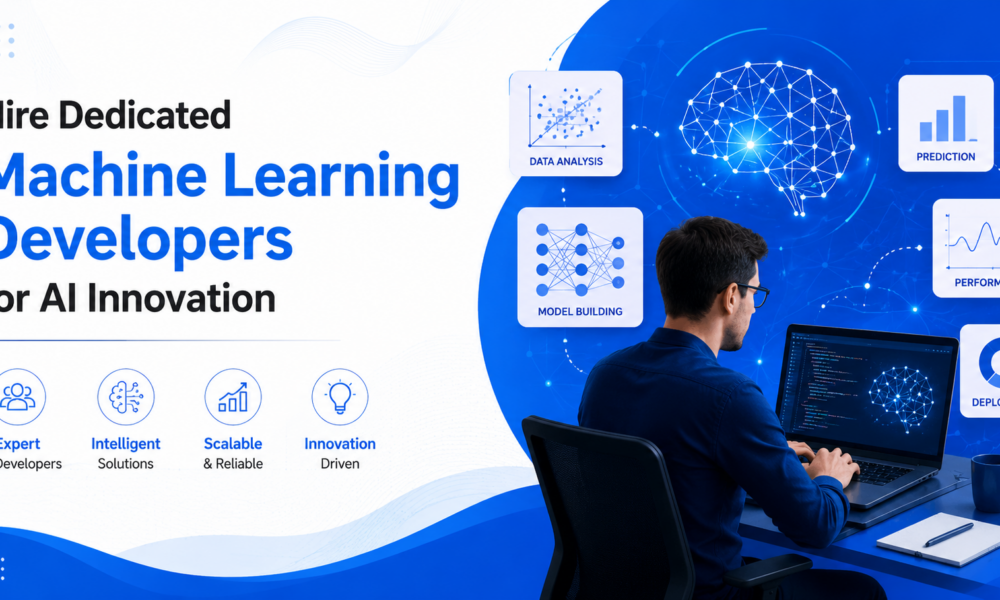
Most businesses don’t fail at machine learning because the technology doesn’t work. They fail because they hire the wrong person for the job and discover the mistake six months and a significant budget later. Machine learning is one of the few technical disciplines where the gap between “can write Python” and “can build a production model that holds up under real-world data drift” is enormous — and largely invisible to a business owner without a technical background doing the hiring. This is not a knock on business owners. It’s simply the reality of a field that moved from academic research to enterprise necessity faster than hiring practices could catch up. If you’re at the point where your business needs predictive capability, automation intelligence, or AI-driven decision-making, the conversation has to start with talent — and getting that decision right shapes everything that follows.
Table Of Content
- Why “We’ll Just Hire a Data Scientist” Is the Wrong Starting Question
- The Real Cost of Getting This Hire Wrong
- Why Remote Hiring Has Become the Smart Default, Not the Compromise
- What to Actually Evaluate When You Hire ML Engineers
- Building Your Team: One Hire vs. a Dedicated Engineering Function
- Making the Decision That Actually Moves Your Business Forward
Why “We’ll Just Hire a Data Scientist” Is the Wrong Starting Question
There’s a common assumption among business owners new to AI hiring that any technical person with “data” or “AI” on their resume can fill the role. This assumption costs companies real money. A data scientist, a data analyst, and a machine learning engineer are not interchangeable roles, even though job boards and recruiters frequently blur the lines between them. A data scientist explores data and builds models in a research environment. A machine learning engineer takes that model — or builds one from scratch — and makes it work reliably in production, at scale, integrated with your actual systems, monitored, versioned, and maintainable by a team that isn’t the original creator.
This distinction matters enormously once you understand what “AI innovation” actually requires inside a real business. A brilliant model sitting in a Jupyter notebook generates zero business value. The value appears only when that model is deployed, serving predictions reliably, retrained as data shifts, and integrated cleanly into the workflows your teams already use. That deployment and engineering discipline is precisely the skill set business owners need to identify and prioritize — and it’s exactly where generalist hiring approaches go wrong.
What separates a true ML engineering hire from an adjacent technical role:
- Production deployment experience — has actually shipped models that serve real users, not just trained models in research settings
- MLOps fluency — understands model versioning, monitoring, retraining pipelines, and rollback strategies
- Systems thinking — can architect how a model fits into existing infrastructure, APIs, and data pipelines
- Data engineering competence — understands how to build reliable data pipelines feeding the model, not just how to consume clean datasets
- Performance and scaling knowledge — knows how to optimize inference speed and resource costs at production volume
- Cross-functional communication — can explain model behavior, limitations, and risk to non-technical stakeholders making business decisions
The Real Cost of Getting This Hire Wrong
Business owners often evaluate the cost of ML hiring purely in salary or contract terms, comparing one candidate’s rate against another’s. This framing misses the larger cost entirely. When you hire ML developers who lack production experience, the visible cost is the paycheck — but the invisible cost is the months spent debugging a model that never should have reached deployment, the customer trust eroded by inaccurate predictions, the compliance exposure from a model nobody can properly explain, and the eventual need to bring in senior talent to rebuild what should have been built correctly the first time.
This pattern repeats across industries with remarkable consistency. A retail company builds a recommendation engine that performs beautifully in testing and then degrades within weeks because nobody engineered for data drift. A logistics company deploys a demand forecasting model that works until seasonal patterns shift and the model has no retraining pipeline to adapt. A fintech startup builds a fraud detection model with strong accuracy metrics that turns out to be biased in ways that create regulatory risk nobody caught before launch. In every case, the root cause traces back to the same place: the hiring decision didn’t account for the full scope of what production-grade machine learning actually demands.
Hidden costs business owners frequently underestimate:
- Technical debt accumulation when models are built without proper architecture, requiring expensive rework later
- Opportunity cost of delayed launches while teams discover gaps in the original build
- Talent turnover costs when underqualified hires get overwhelmed by production complexity and leave
- Reputational risk from customer-facing AI failures that erode trust faster than they can be rebuilt
- Compliance and legal exposure, particularly in regulated industries where model explainability is a legal requirement
- Competitive disadvantage as rivals with properly engineered AI capability move faster and more reliably
Why Remote Hiring Has Become the Smart Default, Not the Compromise
There was a time when remote hiring for specialized technical roles was viewed as a fallback option — what you did when local talent wasn’t available. That era is over, particularly in machine learning, where the talent pool is global, highly mobile, and concentrated in specific regions with strong technical education systems and AI research ecosystems. Business owners who restrict their search to local or in-office candidates are not protecting quality — they are shrinking their access to it.
When you hire remote ML engineers, you gain access to talent pools shaped by some of the strongest engineering education systems globally, often at a more efficient cost structure than equivalent local hiring, without sacrificing the rigor or communication quality your project demands. Modern collaboration tools, asynchronous workflows, and mature remote-first engineering cultures have closed the gap that used to exist between in-office and distributed teams. What matters far more than physical location is whether the engineer has experience working in distributed teams, communicates proactively, and can operate with the autonomy that production ML work requires.
What makes remote ML hiring genuinely effective for business owners:
- Access to specialized expertise that may not exist within your local talent market at all
- Time zone advantages that can enable near-continuous development cycles when teams span regions
- Cost efficiency without compromising on technical depth, particularly when hiring from established tech talent hubs
- Faster hiring cycles, since remote searches aren’t constrained by relocation timelines or local market scarcity
- Built-in documentation discipline, since strong remote engineers default to clear written communication that benefits long-term maintainability
- Flexibility to scale teams up or down as project phases shift, without the overhead of office-based hiring commitments
What to Actually Evaluate When You Hire ML Engineers
Technical interviews for machine learning roles are notoriously easy to get wrong, because the wrong questions reward candidates who are good at whiteboard problems but have never shipped anything that survived contact with real users and real data. Business owners — even technical ones — benefit enormously from restructuring how they evaluate candidates, shifting away from theoretical knowledge checks and toward evidence of practical, production-grade judgment.
The strongest signal in any ML hiring process is not a candidate’s ability to explain an algorithm in the abstract. It’s their ability to walk through a real project, explain the decisions they made under real constraints, describe what went wrong, and articulate what they would change with hindsight. Engineers who have genuinely built and maintained production systems speak about failure differently than those who haven’t — with specificity, with humility, and with a clear sense of the tradeoffs involved. That difference is far more revealing than any algorithm quiz.
Practical evaluation criteria that separate strong candidates from impressive-sounding ones:
- Ask for a specific production model they built — what broke after launch, and how did they fix it?
- Probe their approach to monitoring: how do they know when a deployed model’s performance is degrading?
- Ask how they’ve handled imbalanced or messy real-world data, not clean academic datasets
- Evaluate their comfort explaining model decisions to non-technical stakeholders
- Check their experience with the specific infrastructure your business already uses or plans to use
- Look for evidence of collaboration with data engineers, product teams, and business stakeholders — not just isolated model-building
Building Your Team: One Hire vs. a Dedicated Engineering Function
A question business owners frequently underestimate is scope: do you need one machine learning ML engineer, or do you need a dedicated function — a small team covering data engineering, model development, deployment, and ongoing monitoring? Many businesses start by hiring a single engineer expecting them to cover this entire scope alone, and then wonder why progress is slow or quality suffers. Machine learning in production is rarely a solo discipline at meaningful scale. It benefits from specialization, even within a small team, because the skills required to engineer reliable data pipelines differ meaningfully from the skills required to optimize model architecture or build deployment infrastructure.
For businesses earlier in their AI journey, a single strong generalist engineer with broad production experience can be the right starting point, particularly if the use case is well-defined and contained. But as ambitions grow — multiple models, multiple data sources, real-time inference requirements, compliance considerations — the case for a dedicated team strengthens considerably. This is where engaging a structured hiring partner becomes valuable, because building this team incrementally, with the right sequencing of roles, is its own strategic exercise that benefits from experience most business owners simply haven’t accumulated yet.
Signals that indicate you need a dedicated ML team rather than a single hire:
- Your use cases span multiple business functions, not a single isolated application
- You’re handling sensitive or regulated data requiring dedicated governance and monitoring
- You need real-time inference at scale, not periodic batch predictions
- Your data infrastructure itself needs significant engineering before models can be reliably built
- You expect to iterate rapidly across multiple models simultaneously
- Leadership has committed to AI as a long-term strategic capability, not a single project
Making the Decision That Actually Moves Your Business Forward
The businesses winning with AI right now are not necessarily the ones with the biggest budgets or the flashiest use cases. They are the ones who got the foundational hiring decision right — bringing in engineers who understand that machine learning’s real value lives in production, not in research demos, and who have the discipline to build systems that hold up under the pressure of real users and real data over time. Whether you choose to hire ML engineers as a single strategic addition to your team or build a dedicated function from the ground up, the underlying principle stays the same: evaluate for production judgment, prioritize communication and accountability, and resist the temptation to treat this hire as interchangeable with any other technical role.
AI innovation is not a one-time project with a finish line. It is an ongoing capability that compounds in value the longer it’s engineered well. The business owners who recognize this early — and invest in the right talent from the outset — are the ones who will look back in two years with a genuine competitive advantage, rather than a cautionary tale about an AI initiative that never quite worked. The decision starts with who you bring onto the team, and it starts now.






No Comment! Be the first one.