






Computer Vision in Retail: Use Cases, Benefits, Challenges, and Future Trends
Introduction Retail is changing rapidly as businesses adopt Artificial Intelligence (AI) to improve efficiency and deliver better customer experiences. Traditional retail operations often rely on...

Introduction
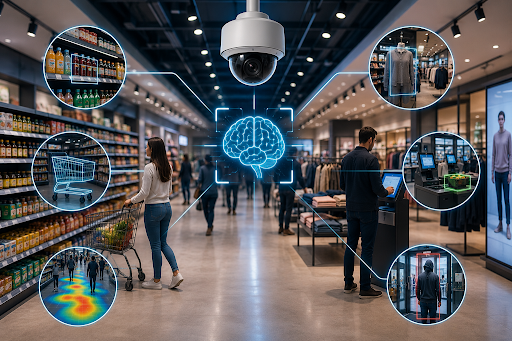
Retail is changing rapidly as businesses adopt Artificial Intelligence (AI) to improve efficiency and deliver better customer experiences. Traditional retail operations often rely on manual inventory checks, security monitoring, and customer observations, which consume time and leave room for human error. Today, computer vision is helping retailers automate these processes by transforming ordinary cameras into intelligent systems that understand and analyze visual information in real time.
Table Of Content
- Introduction
- What Is Computer Vision in Retail?
- How Computer Vision Works in Retail
- Image Capture
- AI and Deep Learning
- Data Processing
- Real-Time Alerts
- Business Analytics
- Key Use Cases of Computer Vision in Retail
- Smart Inventory Management
- Shelf Monitoring and Planogram Compliance
- Automated Checkout
- Loss Prevention
- Customer Behavior Analysis
- Queue Management
- Employee Productivity
- Smart Fitting Rooms
- Product Recognition
- Store Safety and Compliance
- Benefits of Computer Vision for Retailers
- Improved Inventory Accuracy
- Better Customer Experience
- Lower Operating Costs
- Reduced Retail Shrinkage
- Better Business Decisions
- Increased Revenue
- Challenges of Implementing Computer Vision
- Best Practices for Successful Deployment
- Future of Computer Vision in Retail
- Conclusion
- Frequently Asked Questions
- What is computer vision in retail?
- How does computer vision improve inventory management?
- Can computer vision reduce shoplifting?
- Is computer vision suitable for small retailers?
- What technologies support computer vision in retail?
Computer vision in retail combines AI, machine learning, and image recognition to detect products, monitor shelves, analyze customer behavior, and identify operational issues. Instead of simply recording video, AI-powered systems interpret what they see and provide actionable insights that help retailers respond faster to changing conditions.
Whether it is monitoring inventory, preventing theft, reducing checkout queues, or improving product placement, computer vision enables retailers to make data-driven decisions that improve operational efficiency and customer satisfaction. From supermarkets and convenience stores to fashion outlets and electronics retailers, businesses of every size are adopting this technology to stay competitive.
As customer expectations continue to rise, retailers need smarter ways to manage operations while controlling costs. Computer vision is becoming a key component of digital transformation, helping businesses create connected, automated, and intelligent retail environments.
What Is Computer Vision in Retail?
Computer vision is a field of Artificial Intelligence that enables machines to interpret and understand visual data from images and videos. In retail, this technology analyzes information captured by cameras to identify products, customers, employees, and store activities without human intervention.
Unlike traditional surveillance systems that only record footage, computer vision continuously analyzes video streams to detect events, recognize objects, measure customer movement, and monitor inventory. It converts visual information into meaningful business insights that improve decision-making and automate repetitive tasks.
Retailers use computer vision across multiple store operations, including inventory tracking, shelf monitoring, checkout management, customer analytics, loss prevention, and workforce optimization. The technology works alongside existing retail systems such as Point of Sale (POS), inventory management software, Enterprise Resource Planning (ERP), and customer relationship management platforms to create a connected retail ecosystem.
How Computer Vision Works in Retail
Computer vision systems use several technologies that work together to process visual information.
Image Capture
High-definition cameras installed throughout the store continuously capture images and video from shelves, checkout counters, entrances, exits, and shopping aisles.
AI and Deep Learning
Machine learning algorithms analyze every frame to identify products, shopping carts, customers, and store employees. Deep learning models recognize patterns, classify objects, and detect unusual activities.
Data Processing
The collected information is compared with inventory records, planograms, POS transactions, and predefined business rules to identify issues or opportunities.
Real-Time Alerts
If the system detects an empty shelf, checkout fraud, pricing mismatch, or suspicious activity, it immediately sends alerts to store employees or managers for quick action.
Business Analytics
The system generates dashboards and reports that help retailers understand customer behavior, inventory performance, employee productivity, and store operations.
Key Use Cases of Computer Vision in Retail
Smart Inventory Management
Manual inventory counting is time-consuming and often inaccurate. Computer vision continuously monitors shelf stock and warehouse inventory, identifying empty shelves, low inventory levels, damaged products, and misplaced items. This helps employees replenish stock faster while reducing stockouts and overstock situations.
Shelf Monitoring and Planogram Compliance
Retailers invest heavily in product placement strategies. Computer vision automatically verifies whether products are displayed according to the approved planogram. It detects incorrect placement, missing products, incorrect pricing labels, and display inconsistencies that could affect sales.
Automated Checkout
Computer vision powers self-checkout systems and cashier-less shopping experiences by recognizing products without barcode scanning. The technology verifies purchased items, detects scanning errors, and reduces checkout times while improving customer convenience.
Loss Prevention
Retail theft remains one of the industry’s biggest challenges. AI-powered computer vision detects suspicious customer behavior, unscanned products, unusual movements, and unauthorized access. Security teams receive instant alerts, allowing them to respond before losses occur.
Customer Behavior Analysis
Retailers use computer vision to understand how customers move through stores. Heat maps reveal high-traffic areas, while dwell-time analysis shows where shoppers spend the most time. These insights help optimize store layouts, promotional displays, and product positioning.
Queue Management
Long checkout lines negatively affect customer satisfaction. Computer vision monitors queue lengths in real time and alerts managers when additional checkout counters should be opened, reducing waiting times and improving the shopping experience.
Employee Productivity
AI systems track operational activities such as shelf replenishment, customer assistance, and store coverage. Managers gain better visibility into workforce performance without relying on manual observations.
Smart Fitting Rooms
Fashion retailers are implementing AI-powered fitting rooms that recognize garments brought into changing rooms. These systems recommend complementary products, suggest different sizes, and notify staff when customer assistance is needed.
Product Recognition
Computer vision identifies products from images or videos, making visual search easier for customers. Shoppers can upload a photo of a product to find similar items available in the retailer’s catalog.
Store Safety and Compliance
Computer vision also improves workplace safety by detecting blocked emergency exits, spills, overcrowding, or unsafe conditions that require immediate attention.
Benefits of Computer Vision for Retailers
Improved Inventory Accuracy
Continuous monitoring ensures products remain available, reducing inventory discrepancies and minimizing lost sales caused by stock shortages.
Better Customer Experience
Customers benefit from faster checkouts, improved product availability, organized shelves, and personalized shopping experiences.
Lower Operating Costs
Automation reduces the need for manual inspections, inventory counting, and repetitive operational tasks, allowing employees to focus on higher-value activities.
Reduced Retail Shrinkage
Computer vision strengthens store security by identifying theft, fraud, and operational errors before they impact profitability.
Better Business Decisions
Real-time analytics provide valuable insights into customer behavior, store performance, and operational efficiency, enabling retailers to make informed decisions.
Increased Revenue
Optimized merchandising, improved inventory management, and enhanced customer engagement contribute to higher sales and better profitability.
Challenges of Implementing Computer Vision
Although computer vision offers significant advantages, retailers should consider several implementation challenges.
High-quality cameras, computing infrastructure, and AI software require upfront investment. Organizations must also integrate computer vision with existing business systems to maximize its value.
Privacy regulations require businesses to handle customer data responsibly and comply with local laws regarding video surveillance and personal information.
AI models require continuous training to adapt to changing store layouts, lighting conditions, seasonal displays, and new product assortments. Without regular updates, system accuracy may decline over time.
Retailers should also establish clear governance policies to ensure AI is used ethically and transparently while maintaining customer trust.
Best Practices for Successful Deployment
Retailers can maximize return on investment by following a structured implementation strategy.
Start with a pilot project that focuses on one high-value use case, such as inventory monitoring or checkout optimization.
Use existing camera infrastructure whenever possible to reduce deployment costs.
Integrate computer vision with inventory management, POS, ERP, and analytics platforms to create a unified retail ecosystem.
Monitor AI performance regularly and retrain models using real store data to improve accuracy.
Train employees to understand how AI supports daily operations rather than replacing human expertise.
Measure success using key performance indicators such as inventory accuracy, stock availability, checkout speed, shrink reduction, and customer satisfaction.
Future of Computer Vision in Retail
Computer vision continues to evolve alongside advances in Artificial Intelligence and edge computing. Future retail environments will combine computer vision with AI agents, robotics, Internet of Things (IoT) devices, and predictive analytics to automate even more business processes.
Retailers will increasingly deploy autonomous inventory robots, personalized digital shopping assistants, and smart shelves that automatically detect inventory changes. Visual search and virtual try-on technologies will further bridge the gap between online and in-store shopping experiences.
As AI models become more accurate and affordable, computer vision will become a standard technology across retail businesses of all sizes.
Conclusion
Computer vision is transforming the retail industry by enabling intelligent automation across inventory management, checkout operations, customer analytics, and store security. By converting visual data into actionable insights, retailers can improve operational efficiency, reduce costs, minimize losses, and deliver better customer experiences.
Organizations that adopt computer vision strategically, integrate it with existing business systems, and continuously optimize AI models will be better positioned to meet changing customer expectations and compete in the future of retail.
Frequently Asked Questions
What is computer vision in retail?
Computer vision in retail uses AI-powered cameras and machine learning to analyze visual data, automate operations, monitor inventory, improve customer experiences, and reduce retail losses.
How does computer vision improve inventory management?
It continuously monitors shelves, detects low stock, identifies misplaced products, and sends real-time alerts for replenishment.
Can computer vision reduce shoplifting?
Yes. Computer vision identifies suspicious activities, checkout fraud, and unscanned products, allowing retailers to respond quickly and reduce shrinkage.
Is computer vision suitable for small retailers?
Yes. Cloud-based AI platforms and scalable camera solutions have made computer vision more affordable for small and medium-sized retail businesses.
What technologies support computer vision in retail?
Key technologies include Artificial Intelligence, machine learning, deep learning, image recognition, object detection, Optical Character Recognition (OCR), edge computing, cloud computing, and IoT integration.





No Comment! Be the first one.