





How SEO Consulting Transforms Business Growth
In today’s competitive digital landscape, simply having a website is no longer enough to establish a strong online presence. Businesses need to ensure that their websites are visible to the...

In today’s competitive digital landscape, simply having a website is no longer enough to establish a strong online presence. Businesses need to ensure that their websites are visible to the right audience, provide valuable information, and turn visitors into potential customers. This is where strategic SEO consulting becomes an important part of long-term business growth.
Table Of Content
- 1. Understanding Strategic SEO Consulting
- 2. Improving Online Visibility and Search Engine Presence
- 3. Building a Strong Technical Foundation
- 4. Creating Content That Attracts and Engages the Right Audience
- 5. Understanding Competitors and Discovering Market Opportunities
- 6. Strengthening Brand Authority and Customer Trust
- 7. Improving Local Search Visibility
- 8. Turning Website Traffic into Qualified Leads and Customers
- 9. Using Data and Analytics to Make Smarter Decisions
- Conclusion
Search Engine Optimization (SEO) is more than improving keyword rankings or increasing website traffic. It involves understanding customer behavior, analyzing search trends, optimizing website performance, developing useful content, and building a sustainable digital marketing strategy. When implemented correctly, SEO can transform how customers discover, interact with, and trust a business online.
Strategic SEO consulting helps businesses identify opportunities, overcome visibility challenges, and develop customized approaches that align with their commercial objectives. Whether a company is a startup, an established organization, or an expanding e-commerce brand, a well-planned SEO strategy can strengthen its digital footprint and create new growth opportunities.
Let’s explore how professional SEO consulting can help businesses build a stronger online presence and achieve sustainable digital success.
1. Understanding Strategic SEO Consulting
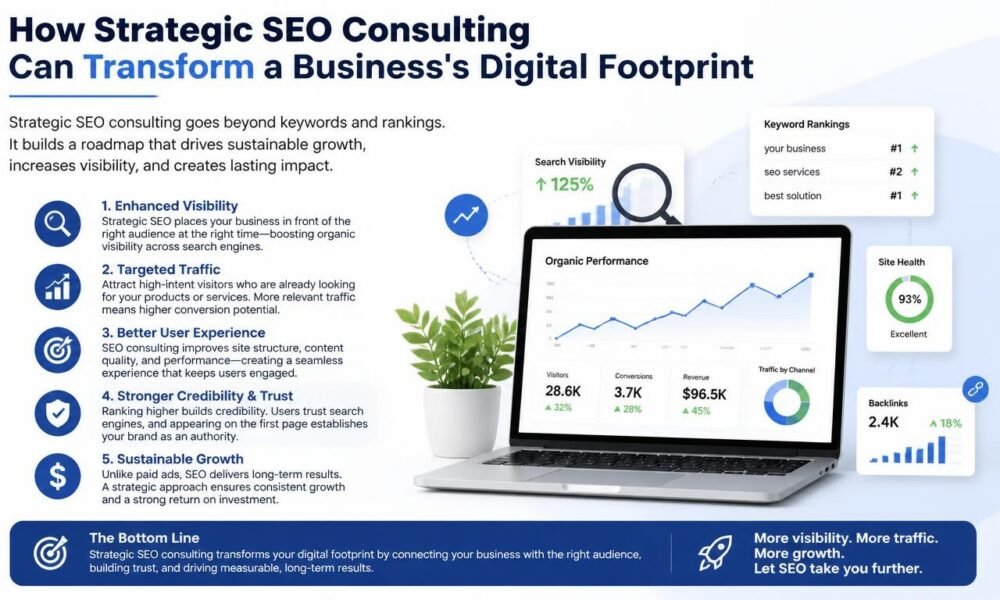
Strategic SEO consulting is a structured approach to improving a website’s visibility and performance across search engines. Instead of implementing random optimization techniques, experienced SEO consultants evaluate a business’s current digital position and create a roadmap based on its industry, target audience, competitors, and growth objectives. Businesses looking to strengthen their online presence can benefit from working with the best SEO agency in India, which combines industry expertise, data-driven strategies, and customized optimization techniques to deliver sustainable digital growth.
A strategic approach considers several important areas, including:
- Technical website performance and search engine accessibility.
- Keyword research and search intent analysis.
- Website content quality and topical relevance.
- Competitor research and market opportunities.
- On-page and off-page optimization.
- User experience and website navigation.
- Conversion tracking and performance measurement.
An experienced SEO consultant does not focus exclusively on increasing organic traffic. The objective is to attract relevant visitors who are genuinely interested in the products or services a business offers.
For example, a company providing accounting software may receive thousands of website visits from people searching for general financial information. However, traffic from businesses searching for accounting automation solutions may generate significantly more qualified leads.
This difference highlights the importance of aligning SEO activities with actual business goals.
2. Improving Online Visibility and Search Engine Presence
One of the biggest challenges businesses face is getting discovered online. Even companies offering excellent products and services can struggle to attract customers if their websites do not appear prominently in relevant search results.
Strategic SEO consulting helps address this challenge by identifying the search terms potential customers use when looking for particular products, services, or solutions.
Through comprehensive keyword research, consultants identify opportunities across different stages of the customer journey.
For example:
- Informational searches: Users looking for answers, explanations, or guidance.
- Commercial searches: Users comparing different solutions or service providers.
- Transactional searches: Users who are ready to purchase or contact a business.
By targeting relevant search opportunities, businesses can increase their visibility among audiences who are more likely to engage with their offerings.
SEO consultants also examine search engine results pages, competitor positioning, and keyword difficulty to identify realistic opportunities.
Rather than chasing highly competitive keywords without a clear strategy, businesses can focus on relevant search terms that offer meaningful growth potential.
Over time, consistent optimization can help improve search visibility, strengthen brand recognition, and attract a steady stream of relevant organic visitors.
3. Building a Strong Technical Foundation
A visually attractive website does not automatically perform well in search engines. Technical issues can prevent search engines from discovering, crawling, understanding, or properly indexing website pages.
Strategic SEO consulting includes a detailed technical audit to identify problems that may affect website performance.
Common technical SEO issues include:
- Slow-loading website pages.
- Broken internal and external links.
- Incorrect redirect configurations.
- Duplicate content and indexing problems.
- Missing or incorrectly implemented canonical tags.
- Poor mobile usability.
- Incomplete XML sitemaps.
- Incorrect robots.txt configurations.
- Unstructured website architecture.
Addressing these issues creates a stronger technical foundation for future SEO activities.
Website speed and mobile usability are particularly important because customers expect websites to load quickly and function smoothly across different devices.
Consultants may also evaluate Core Web Vitals, which measure important aspects of page experience, including loading performance, interactivity, and visual stability.
A technically optimized website provides a better experience for visitors while making it easier for search engines to process its content.
However, technical optimization should always be prioritized according to actual business impact. Fixing critical indexing problems, for example, is generally more important than making minor technical adjustments that produce little measurable improvement.
4. Creating Content That Attracts and Engages the Right Audience
Content is one of the most important elements of a successful SEO strategy. It helps businesses answer customer questions, demonstrate expertise, communicate their value, and establish authority within their industries.
However, publishing blog posts regularly does not guarantee better search performance.
Businesses need content that addresses genuine audience needs and provides information that is useful, accurate, and easy to understand.
An SEO consultant develops a content strategy based on keyword research, customer search intent, competitor analysis, and the business’s expertise.
This strategy may include:
- Informative blog articles.
- Detailed service pages.
- Industry guides and educational resources.
- Frequently asked questions.
- Product comparison pages.
- Case studies and customer success stories.
- Supporting content around important industry topics.
For instance, a digital marketing company could create educational articles about technical SEO, local search optimization, content strategy, website audits, and organic lead generation.
These interconnected resources help establish topical relevance and provide visitors with multiple ways to explore the company’s expertise.
A well-planned content strategy also reduces the chances of publishing multiple pages targeting the same search intent.
Instead of creating content simply to increase website volume, businesses should focus on developing valuable resources that answer customer questions and support their purchasing decisions.
5. Understanding Competitors and Discovering Market Opportunities
Your competitors are not just businesses offering similar products or services. They are also websites competing for the same audience’s attention in search results.
Strategic SEO consulting involves analyzing competing websites to understand what is working for them and where opportunities exist.
A comprehensive competitor analysis may examine:
- Organic keyword rankings.
- High-performing landing pages.
- Content quality and topical coverage.
- Backlink profiles.
- Website structure and navigation.
- Search visibility across important categories.
- Content gaps and underserved topics.
For example, suppose three companies operate in the same industry. One competitor may dominate informational searches, another may rank well for service-related keywords, and a third may attract customers through location-specific landing pages.
An SEO consultant can use these insights to identify areas where your business has the potential to compete more effectively.
The objective is not to copy competitors. It is to understand the market, identify weaknesses in existing search results, and develop a stronger strategy.
This approach allows businesses to allocate resources more intelligently and pursue opportunities that align with their capabilities.
6. Strengthening Brand Authority and Customer Trust
A strong digital footprint is not measured only by how frequently a website appears in search results. It also depends on how customers perceive the brand when they encounter it online.
When a business consistently publishes helpful content, demonstrates industry knowledge, and maintains a professional website, it creates opportunities to build credibility.
Google’s Search Quality Evaluator Guidelines discuss the importance of experience, expertise, authoritativeness, and trustworthiness (commonly referred to as E-E-A-T) when evaluating content quality.
Although E-E-A-T is not a single direct ranking factor, its principles provide useful guidance for creating reliable and people-focused content.
Strategic SEO consulting can support these principles through activities such as:
- Publishing content reviewed by knowledgeable professionals.
- Including accurate company information and contact details.
- Showcasing genuine customer testimonials.
- Creating detailed case studies.
- Providing credible references and sources.
- Maintaining consistent brand information across online platforms.
- Earning relevant editorial mentions and quality backlinks.
Backlinks from relevant and reputable websites can also help search engines understand how a business fits within its broader industry.
However, link building should prioritize relevance and genuine editorial value rather than artificial link volume.
A trustworthy digital presence makes it easier for potential customers to evaluate a business and feel confident about engaging with it.
7. Improving Local Search Visibility
For businesses serving specific cities, regions, or communities, local SEO can play an important role in attracting customers.
People frequently search for nearby service providers, local stores, professional consultants, restaurants, and other businesses using location-based search terms.
Strategic SEO consulting helps businesses improve their visibility for these searches through local optimization techniques.
Important local SEO activities include:
Google Business Profile optimization: Maintaining accurate business details, categories, operating hours, service information, photographs, and other relevant information.
Local keyword targeting: Identifying search phrases that combine services with relevant city or neighborhood names.
Business information consistency: Ensuring that the business name, address, and phone number are accurate across important directories.
Customer review management: Encouraging genuine customer feedback and responding professionally to reviews.
Location-specific landing pages: Creating useful pages for the geographical areas a business genuinely serves.
For example, a web development company operating in multiple Indian cities may benefit from dedicated service pages targeting relevant local audiences.
Local optimization helps businesses connect with customers who are actively searching for nearby solutions.
It can also improve the overall consistency of their online business information.
8. Turning Website Traffic into Qualified Leads and Customers
Increasing organic traffic is valuable, but traffic alone does not guarantee business growth.
A website may attract thousands of visitors without generating meaningful inquiries or sales. This often happens when the content does not match user expectations or the website fails to guide visitors toward the next step.
Strategic SEO consulting considers conversion optimization alongside search visibility.
Consultants analyze how visitors interact with important website pages and identify opportunities to improve the customer journey.
Some useful conversion optimization techniques include:
- Creating clear and relevant calls to action.
- Improving contact forms and inquiry processes.
- Making service descriptions easier to understand.
- Adding genuine testimonials and customer success stories.
- Improving mobile navigation.
- Reducing unnecessary distractions.
- Aligning landing page content with search intent.
For example, a visitor searching for enterprise SEO solutions should ideally land on a page that explains the company’s services, experience, approach, and potential business benefits.
A generic homepage may not provide the information needed to encourage that visitor to make an inquiry.
By improving the relationship between search intent, landing page content, and conversion opportunities, businesses can generate more value from their existing organic traffic.
9. Using Data and Analytics to Make Smarter Decisions
Successful SEO requires continuous evaluation. Search algorithms, customer behavior, competitor strategies, and industry trends can change over time.
Strategic SEO consultants use analytics and performance data to understand whether optimization activities are producing meaningful results.
Some important performance indicators include:
- Organic website traffic.
- Keyword ranking trends.
- Search impressions and clicks.
- Click-through rates.
- Organic conversion rates.
- Qualified leads generated through organic search.
- Landing page performance.
- Engagement and user behavior.
- Revenue attributed to organic search.
Tools such as Google Analytics 4 and Google Search Console provide valuable information about website traffic, search visibility, and user interactions.
For example, if a website receives strong impressions but relatively few clicks for an important search term, the consultant may investigate whether the page title and meta description accurately communicate the page’s value.
Similarly, if a landing page attracts substantial organic traffic but generates few inquiries, its content, calls to action, and user experience may need improvement.
Data-driven optimization helps businesses move beyond assumptions and make decisions based on measurable performance.
It also makes it easier to understand which SEO activities deserve greater investment.
Conclusion
Strategic SEO consulting can transform a business’s digital footprint by connecting technical optimization, meaningful content, audience research, brand authority, and conversion-focused strategies into one coordinated growth plan.
It helps businesses move beyond the traditional goal of achieving higher keyword rankings and focus on becoming more discoverable, credible, and competitive in their industries.
From improving website performance and attracting qualified visitors to strengthening brand recognition and preparing for AI-powered search experiences, a well-planned SEO strategy can create opportunities for sustainable digital growth.



No Comment! Be the first one.