






Indian Brands Build Visibility Beyond Rankings
Getting more visitors to a website is often treated as the ultimate goal of search engine optimization. Businesses celebrate when organic traffic increases, rankings improve, and more people discover...

Getting more visitors to a website is often treated as the ultimate goal of search engine optimization. Businesses celebrate when organic traffic increases, rankings improve, and more people discover their website through search engines. But traffic alone does not necessarily generate revenue.
Table Of Content
- What Is a Qualified Lead?
- 1. They Start With Search Intent, Not Just Keywords
- 2. They Build Content Around Customer Problems
- 3. They Optimize Landing Pages for Conversions
- 4. They Target Long-Tail and Commercial Search Terms
- 5. They Create Topic Authority
- 6. They Use Internal Linking to Guide Visitors
- 7. They Strengthen Trust and Credibility
- 8. They Improve Local Search Visibility
- 9. They Optimize Calls to Action
- 10. They Improve Technical SEO and User Experience
- 11. They Use Analytics to Identify What Actually Converts
- From Traffic Generation to Business Growth
- Final Thoughts
A website can attract thousands of visitors every month and still produce very few enquiries or sales.
The real value of SEO comes from attracting the right visitors and guiding them toward meaningful actions. This is where professional SEO teams make a significant difference. Instead of focusing solely on rankings and traffic volume, experienced SEO professionals build strategies designed to connect search visibility with business objectives.
From understanding search intent and creating relevant content to optimizing landing pages and measuring conversions, professional SEO teams use multiple techniques to turn website visitors into qualified leads.
What Is a Qualified Lead?
Before discussing how SEO generates leads, it is important to understand what makes a lead “qualified.”
A website visitor becomes a lead when they take an action that indicates interest in a product or service. This could include:
- Filling out a contact form
- Requesting a quote
- Booking a consultation
- Calling the business
- Downloading a useful resource
- Signing up for a product demonstration
- Sending an enquiry through live chat
- Subscribing to a relevant service
- Making a purchase
However, not every lead has the same value.
Someone who submits a form simply to ask a general question may not be ready to buy. For example, a visitor searching for an SEO Company in India, reading several relevant service pages, comparing pricing information, and then requesting a consultation is much more likely to be a genuinely qualified prospect. This is why professional SEO teams focus on attracting users with strong purchase intent rather than simply increasing overall website traffic.
Professional SEO teams focus on attracting visitors who have a genuine need and are more likely to move through the sales process.
1. They Start With Search Intent, Not Just Keywords
One of the biggest differences between basic SEO and professional SEO is the way keywords are approached.
It is easy to create a list of high-volume keywords and optimize pages around them. But search volume does not tell the complete story.
Professional SEO teams investigate search intent — the reason behind a person’s search.
For example, consider these searches:
- “What is SEO?”
- “How does SEO work?”
- “best SEO agency for small business”
- “SEO services pricing”
- “hire SEO consultant”
Although all of these searches relate to SEO, they represent different stages of the buyer journey.
The first search is primarily informational. The user is learning.
The second may indicate deeper research.
The third shows commercial investigation.
The fourth suggests that the user may be evaluating providers or budgets.
The final search demonstrates strong transactional intent.
An effective SEO strategy creates content for different stages while placing greater emphasis on keywords that can attract potential customers.
By matching content with search intent, SEO teams reduce irrelevant traffic and increase the likelihood that visitors will have a genuine interest in what the business offers.
2. They Build Content Around Customer Problems
Ranking for keywords is only one part of the equation. Once a visitor arrives, the website needs to provide a useful reason to stay.
Professional SEO teams research the questions, challenges, objections, and goals of a company’s target audience.
They then create content that addresses those needs.
For example, a software company might publish content covering:
- Common problems with existing software
- How to compare software solutions
- Implementation guides
- Industry-specific challenges
- Cost considerations
- Product comparison articles
- Case studies
- Frequently asked questions
This approach helps businesses attract people who are actively researching solutions.
More importantly, useful content builds trust.
A visitor who finds clear and relevant answers is more likely to view the company as knowledgeable and credible. That trust can eventually influence the decision to request a quote, schedule a call, or purchase a product.
3. They Optimize Landing Pages for Conversions
Getting a visitor to a website is only the beginning.
If the landing page is confusing, slow, poorly designed, or missing a clear next step, the visitor may leave without taking any action.
Professional SEO teams work closely with website and conversion optimization specialists to improve landing pages.
Effective landing pages typically include:
- A clear headline
- A strong value proposition
- Relevant supporting information
- Trust signals
- Customer reviews or testimonials
- Case studies where appropriate
- Clear calls to action
- Easy-to-use enquiry forms
- Mobile-friendly design
- Fast page loading
- Simple navigation
The goal is to remove unnecessary friction.
For example, instead of forcing a visitor to navigate through several pages to find a contact form, a well-optimized service page can provide a clear “Request a Consultation” or “Get a Quote” option at an appropriate point in the user’s journey.
SEO brings the visitor to the page. Conversion-focused optimization gives that visitor a reason to take the next step.
4. They Target Long-Tail and Commercial Search Terms
High-volume keywords can generate substantial traffic, but they are not always the best source of leads.
Long-tail keywords often have lower search volume but much stronger relevance.
Consider the difference between:
“digital marketing”
and
“digital marketing agency for healthcare businesses.”
The first search is extremely broad. The person could be looking for information, courses, tools, agencies, jobs, or general advice.
The second search is much more specific. Someone searching for it is more likely to have a particular business requirement.
Professional SEO teams identify these specific opportunities and create targeted pages around them.
Long-tail and commercial keywords can help businesses attract visitors who already understand what they need.
That makes them particularly valuable for lead generation.
5. They Create Topic Authority
Search engines increasingly rely on a broad understanding of topics rather than evaluating pages based on isolated keywords alone.
Professional SEO strategies therefore often involve building topic clusters.
A business may create a central service or topic page supported by multiple detailed articles.
For example, a company offering cybersecurity services could develop content around:
- Cybersecurity risk assessments
- Network security
- Cloud security
- Data protection
- Security audits
- Employee security training
- Common cyber threats
- Compliance requirements
These resources can link naturally to relevant service pages.
This structure serves two purposes.
First, it provides visitors with more useful information.
Second, it demonstrates depth and expertise around the subject.
When visitors repeatedly find helpful resources from the same business, they may become more comfortable considering that company as a potential service provider.
6. They Use Internal Linking to Guide Visitors
Internal links are often discussed in terms of SEO, but they can also play an important role in lead generation.
Imagine someone lands on a blog article explaining how to identify common website security problems.
Rather than ending the article without direction, the page could link to:
“Learn more about our website security audit service.”
The visitor can move naturally from educational content to a relevant commercial page.
This creates a pathway:
Search → Informational Content → Relevant Service → Enquiry
Professional SEO teams strategically connect pages based on user intent.
The objective is not to add links randomly. It is to help visitors discover the next piece of information they are likely to need.
7. They Strengthen Trust and Credibility
People rarely submit their personal information or spend money with a company they do not trust.
SEO teams therefore consider credibility as part of the broader customer journey.
A strong website may include:
- Client testimonials
- Reviews
- Industry certifications
- Awards
- Case studies
- Author information
- Company experience
- Expert insights
- Clear contact information
- Transparent service descriptions
Case studies can be especially effective.
Instead of simply claiming that a company delivers results, a case study can explain the original challenge, the strategy used, and the outcome achieved.
This gives potential customers evidence that the business understands their problems and can deliver practical solutions.
8. They Improve Local Search Visibility
For businesses serving specific locations, local SEO can be an important source of qualified leads.
Someone searching for a service in a particular city or region often has stronger purchase intent than someone performing a broad informational search.
Professional SEO teams optimize local visibility by improving relevant website pages, business information, location-specific content, reviews, and other local search signals.
Location-focused landing pages can also help businesses address the needs of customers in different markets.
For example, a service provider operating across multiple cities may create genuinely useful pages explaining availability, services, and customer needs in each location rather than publishing duplicate pages with only the city name changed.
The result is more relevant visibility and better opportunities to generate local enquiries.
9. They Optimize Calls to Action
A call to action, commonly called a CTA, tells the visitor what to do next.
Examples include:
- Request a Quote
- Book a Consultation
- Get Started
- Schedule a Demo
- Contact Our Team
- Download the Guide
- Speak With an Expert
Professional SEO teams consider where and how CTAs appear on a page.
A CTA placed immediately after a visitor arrives may feel premature. The same CTA placed after the visitor has received useful information may feel like a natural next step.
Different visitors may also respond to different offers.
Someone at the beginning of the research process may prefer to download a guide. A visitor comparing providers may be ready to request a quote.
Understanding these differences allows businesses to create more effective conversion paths.
10. They Improve Technical SEO and User Experience
Technical SEO may seem unrelated to lead generation, but website performance has a direct impact on user experience.
Slow pages, broken links, confusing navigation, mobile usability problems, and technical errors can prevent visitors from reaching conversion points.
Professional SEO teams regularly evaluate technical factors such as:
- Website speed
- Mobile usability
- Crawlability
- Indexing
- Site architecture
- Broken pages
- Redirects
- Structured data
- Security
- Core web performance
- Duplicate content
A technically healthy website makes it easier for both search engines and users to navigate the site.
More importantly, reducing technical friction can help prevent potential customers from abandoning the website before making an enquiry.
11. They Use Analytics to Identify What Actually Converts
Professional SEO is not based on assumptions alone.
SEO teams use analytics and conversion data to understand which pages, keywords, traffic sources, and user journeys contribute to business outcomes.
For example, an analytics review may reveal that:
- One blog generates thousands of visitors but very few leads.
- A smaller service page produces fewer visitors but significantly more enquiries.
- Visitors who read case studies convert at a higher rate.
- Certain landing pages have unusually high exit rates.
- Mobile visitors abandon a form more frequently than desktop users.
These insights allow SEO teams to refine the strategy.
Instead of simply asking, “How much traffic did SEO generate?” businesses can ask more valuable questions:
How many qualified leads came from organic search?
Which pages generated those leads?
Which topics attracted potential customers?
Which conversions eventually became sales?
This shift from traffic reporting to revenue-focused measurement makes SEO far more valuable to a business.
From Traffic Generation to Business Growth
The biggest misconception about SEO is that success means getting a website to rank number one.
Rankings are important, but they are only part of the journey.
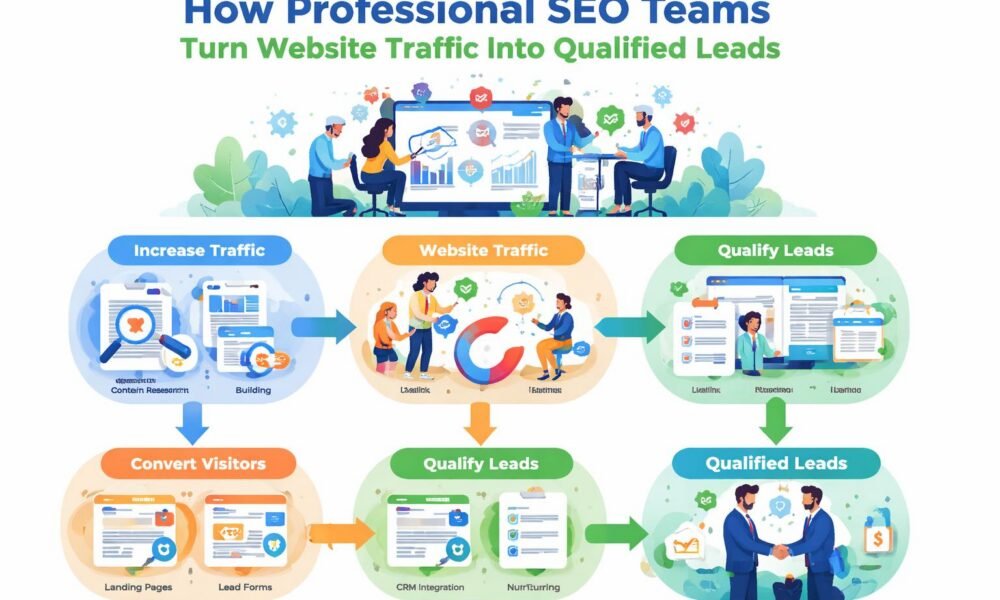
A successful SEO strategy connects several stages:
Relevant Search → Valuable Content → Trust → Strong User Experience → Conversion → Qualified Lead → Customer
Final Thoughts
Turning website traffic into qualified leads requires much more than inserting keywords into web pages.
It requires an understanding of customers, search intent, content strategy, technical performance, conversion optimization, trust, analytics, and the sales process.
Professional SEO teams bring these elements together to create a website that does more than attract visitors. They help transform organic search visibility into meaningful business opportunities.
For companies investing in SEO, the most important question should therefore not simply be “How much traffic are we getting?”
A better question is:
“Are we attracting the right people, and are we giving them a clear reason to become customers?”
When SEO is built around that objective, search traffic becomes more than a number in an analytics report. It becomes a sustainable source of qualified leads and long-term business growth.





No Comment! Be the first one.