






Why Machama Became the Loved Radio Drama in Kashmir
People in Kashmir used to gather around the radio every evening. They would listen to news, music and stories that were about their lives. One of the popular shows wasMachama. It was created by...

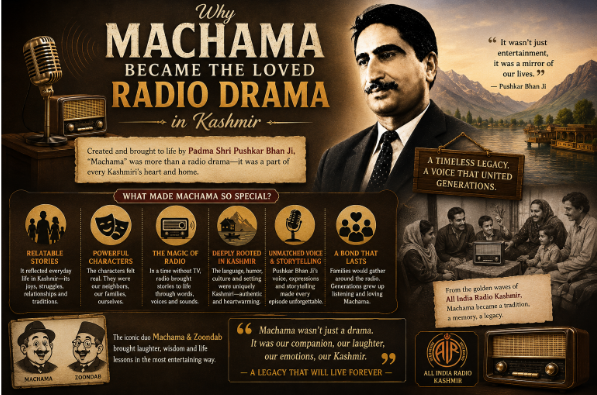
People in Kashmir used to gather around the radio every evening. They would listen to news, music and stories that were about their lives. One of the popular shows wasMachama. It was created by Pushkar Bhan, who was a good writer and broadcaster. Machama was more than a show. It was a part of people’s daily lives. The characters were memorable and the language was real. The jokes were funny. Today people still remember Machama with love.
Table Of Content
- Radio: The Heartbeat of Kashmir Before Television
- Pushkar Bhan’s Vision for Meaningful Entertainment
- The Birth of Machama
- Characters That Felt Like Family
- Authentic Kashmiri Language Made the Difference
- Comedy That Never Hurt People
- Humour That Encouraged Social Change
- A Weekly Family Tradition
- The Power of Memorable Dialogue
- Reflecting Kashmiri Life
- Preserving the Kashmiri Language
- Recognition Beyond Entertainment
- Influence on Future Generations
- The Loss of the Original Recordings
- Why Machama Matters Today
- Conclusion
- Frequently Asked Questions (FAQs)
- 1. What is Machama ?
- 2. Why was Machama so popular?
- 3. Who created Machama ?
- 4. Did Machama receive any awards?
- 5. Why is Machama important today?
For people Machama was not just something to listen to. It was a way to learn about life. The show had characters that were like people with their own problems and strengths. The show also talked about issues but in a way that was funny and not boring. Pushkar Bhan was very good at making people laugh. He also wanted to make them think.
This article is about why Machama became so popular. We will look at how it was made, what made it special and why people still love it today.
Radio: The Heartbeat of Kashmir Before Television
To understand why Machama was so popular we need to think about what life was like in Kashmir before television. People did not have ways to get information or entertainment so they relied on the radio. All India Radio Srinagar was one of the important places for culture and news. It had shows for everyone from children to people.
Radio was special because it felt personal. People would imagine the stories and characters in their minds, which made it feel more real. It was like having a friend in the room talking to you. When Pushkar Bhan started working at the radio station he knew he had a chance to make a difference.
Pushkar Bhan’s Vision for Meaningful Entertainment
Pushkar Bhan was a man with an idea. He wanted to make shows that would make people laugh. Also think. He did not want to make silly jokes or stories that had no meaning. He wanted to talk about life with all its problems and joys. He believed that if people could see themselves in the stories they would be more interested.
Bhan’s stories were about people with their own struggles and dreams. He would take situations and turn them into funny stories.. He would also talk about important issues, like how people should treat each other. His goal was to make people smile but to make them think about their own lives.
This approach made Machama very special. People could see themselves in the characters and stories. They felt like they were listening to their families and friends.
The Birth of Machama
Machama was a change in Kashmiri broadcasting. Of just making individual shows Pushkar Bhan created characters that would come back every week. This made people feel like they were part of a community like they knew the characters personally.
The main character, Machama became a household name. People loved him because he was like a friend or a family member. The other characters, like Kaak and Khadiji were also very popular. They were all different with their ways of speaking and thinking.
These characters were not superheroes or special people. They were ordinary Kashmiris with their own problems and strengths. That is why people loved them so much.
Characters That Felt Like Family
The characters in Machama were what made the show so popular. They were like people with their own quirks and habits. Pushkar Bhan worked hard to make them feel real so people could relate to them.
Some characters were confident while others were shy. Some were funny while others were serious.. They all felt like people you could know in real life.
People would often say that someone in their family was like Machama or Kaak. This showed that the characters were real to them like friends or family members.
The characters in Machama also changed the way people talked. They would use phrases and words from the show in their conversations. This showed how much the show was a part of their lives.
Authentic Kashmiri Language Made the Difference
The language used in Machama was also very important. Pushkar Bhan wrote the dialogue in a way that sounded like real people talking. He used expressions and idioms that people in Kashmir would use every day.
This made the show feel very authentic like it was really about Kashmiri people and their lives. The language was not too formal or too fancy. It was like how people spoke at home.
The show also helped to preserve the Kashmiri language. It kept expressions and words alive even as younger people started to use more Hindi and English.
For people who study languages Machama is a resource. It shows how people in Kashmir used to speak. It helps to keep the language alive.
Comedy That Never Hurt People
The comedy in Machama was also very special. It did not make fun of people. Hurt their feelings. Instead it was funny because it was about situations and the people in them.
Pushkar Bhan believed that comedy should make people laugh but not at someone’s expense. He wanted to make people smile. Also to make them think about their own lives and behaviors.
The comedy in Machama was, like a mirror reflecting back at the people who listened to it. It showed them their strengths and weaknesses but in a way that was gentle and kind.
This kind of comedy is very rare today. Most comedies make fun of someone or something. Machama was different. It was funny. It was also respectful and kind.
Humour That Encouraged Social Change
Machama used humour in a special way. It did not just make people laugh. Also helped them think about their society. Pushkar Bhan knew that people are more likely to listen to truths when they are presented in a warm and witty way. So each episode of Machama was entertaining. It also made people think about the world around them.
Machama talked about issues that affected families in Kashmir. These issues included fights within families not having a job, strange social customs, education, government offices, money problems and differences between young people. The characters in the drama found themselves in situations that showed what happens when people are prejudiced, greedy, superstitious or make decisions.
This approach made Machama unique. People did not feel like they were being taught a lesson. Instead they laughed at situations that they could relate to and slowly started to see patterns in their own lives. In this way Pushkar Bhan used comedy to make people more aware of the world around them.
The success of Machama showed that entertainment in languages can help society without losing its humour or creativity.
A Weekly Family Tradition
When Machama was on the radio it was a part of family life in Kashmir. People would gather around the radio to listen to their programmes and Machama was one of the most anticipated ones.
Families would change their evening plans so that everyone could listen to Machama. Parents, grandparents and children would all sit together. Listen to the programme. This created a shared experience that brought people together across ages and backgrounds.
Unlike today when people often watch or listen to things on their phones Machama brought families together. They would all laugh at the jokes and talk about the episodes afterwards. The programme became a topic of conversation in schools, workplaces, markets and neighbourhoods.
This shared experience helped to strengthen community bonds. People who had never met before could instantly connect by talking about the episode of Machama or quoting a funny line from the programme. Few entertainment programmes have been able to bring people like this.
The Power of Memorable Dialogue
Pushkar Bhan was very good at writing conversations that sounded natural. His dialogues were like the conversations people have in their lives.
He did not write speeches but instead used short and witty exchanges that revealed the characters’ personalities. The humour in Machama came from the characters and their conversations rather than from jokes or slapstick comedy.
Many of the dialogues from Machama became a part of speech. People would repeat them during family conversations, social gatherings and at work. Certain phrases from the programme became so popular that they are still used today showing how much Machama influenced Kashmiri culture.
The strength of these dialogues lay in their simplicity. Today many people can still remember specific lines from Machama because they reflected real human emotions and experiences.
Reflecting Kashmiri Life
Another reason why Machama was so popular was that it reflected everyday life in Kashmir. Pushkar Bhan did not use plots or extraordinary events but instead focused on ordinary situations that people could relate to.
The characters in Machama worried about things like household expenses, education, marriage proposals, fights with neighbours, government offices, festivals and family responsibilities. These were the issues that people in Kashmir faced in their everyday lives.
Because the stories were so real people felt connected to them. Every episode reminded them of someone they knew whether it was a family member, a neighbour, a colleague or even themselves.
This realism also made Machama a cultural document. Today the programme provides insights into the social customs, language, humour and family relationships that characterized Kashmiri life in the past.
Preserving the Kashmiri Language
Pushkar Bhan did a service to the Kashmiri language by using it in Machama. At a time when Hindi and English were becoming more popular in education and media, Machama celebrated the Kashmiri language in its most authentic form.
The dialogues in the programme were rich with idioms, proverbs and local expressions that reflected everyday conversation. This helped to preserve the Kashmiri language. Made people proud of their mother tongue.
For listeners Machama reinforced their pride in the Kashmiri language. Older generations appreciated hearing expressions that reflected their cultural identity.
Language preservation is not about dictionaries and academic studies. It is also about stories, songs, theatre and radio. By reaching thousands of homes every week *Machama* ensured that the Kashmiri language remained a living language of humour, emotion and creativity.
Today researchers and cultural historians recognize programmes like *Machama* as linguistic records that document the spoken language of an earlier generation.
Recognition Beyond Entertainment
Machama became so popular that it brought recognition to Pushkar Bhan’s work. In 1976 he received the Sahitya Akademi Award, one of India’s literary honours for Machama.
This recognition was significant because it showed that radio writing could be considered literature. Traditionally literature was associated with novels, poetry and printed drama. Machama proved that scripts written for broadcasting could also have lasting value.
The award elevated the status of Kashmiri-language broadcasting. Encouraged greater appreciation for regional literature across India.
For Pushkar Bhan the award confirmed that entertainment and literary excellence could go hand in hand.
Influence on Future Generations
The influence of Machama extended beyond its original broadcasts. Many Kashmiri writers, actors, broadcasters and comedians have been inspired by Pushkar Bhan’s work.
His storytelling techniques, realistic characters and balanced use of humour became models for generations of performers. Many radio dramas and television comedies produced in Kashmir borrowed elements of the style he had perfected.
Importantly Pushkar Bhan showed that regional-language entertainment could achieve both artistic excellence and mass popularity. Young writers learned that authenticity and cultural relevance mattered more than production values.
His legacy continues to inspire artists who want to preserve Kashmiri identity through literature, theatre, broadcasting and digital media.
The Loss of the Original Recordings
Despite the cultural significance of Machama It is sad that many of the original recordings have been lost from broadcasting archives.
These recordings were not old radio programmes. They preserved examples of Kashmiri speech, performance techniques, humour and social history.
The loss has concerned historians, broadcasters and fans of Pushkar Bhan’s work. Many have called for efforts to find surviving recordings in collections and private archives before more of this heritage disappears.
Digitizing whatever material remains is very important. This would allow future generations to experience Machama not through written descriptions but through the original voices that captivated audiences for decades.
Why Machama Matters Today
Today people consume entertainment through smartphones, streaming platforms, podcasts and social media.Machama still holds a special place in Kashmiri cultural memory.
The themes of Machama are still relevant today. Families still face challenges like changing traditions, financial pressures, education, employment and relationships. Human nature has not changed much which is why the humour in Machama still resonates with people.
The programme also reminds creators that meaningful entertainment does not require technology. Strong characters, dialogue and thoughtful storytelling are still the foundation of every memorable drama.
As people become more interested in preserving languages, Machama has become important again as an example of how entertainment can strengthen cultural identity while remaining accessible to ordinary audiences.
Conclusion
Machama became the most loved radio drama in Kashmir because it combined entertainment, literature, language preservation and social awareness in a way that appealed to listeners of all ages. Pushkar Bhan understood his audience well. Of creating unrealistic heroes or exaggerated comedy he presented ordinary people facing ordinary challenges with warmth, intelligence and compassion. His unforgettable characters, Kashmiri dialogue and gentle satire made Machama a shared cultural experience.
The programme entertained families for years while quietly encouraging them to think about values and everyday behaviour. It strengthened pride in the Kashmiri language, inspired generations of writers and performers and earned recognition as one of the finest achievements in regional broadcasting.
Although many original recordings are lost, Machama lives on in the memories of listeners who still recall its characters and conversations with affection. Its enduring popularity is a testament to Pushkar Bhan’s talent and the power of storytelling rooted in culture, language and everyday life.
Frequently Asked Questions (FAQs)
1. What is Machama ?
Machama is a Kashmiri radio drama written by Pushkar Bhan. It was one of the popular programmes broadcast by All India Radio Srinagar and is remembered for its humour, memorable characters and social commentary.
2. Why was Machama so popular?
Machama was popular because it combined Kashmiri language, relatable characters, gentle humour and meaningful social messages making it enjoyable, for listeners of all ages.
3. Who created Machama ?
Machama was created by Pushkar Bhan, a Kashmiri playwright, actor, broadcaster and recipient of the Padma Shri and the Sahitya Akademi Award.
4. Did Machama receive any awards?
Yes. Pushkar Bhan received the Sahitya Akademi Award in 1976 for Machama recognizing its cultural significance.
5. Why is Machama important today?
Machama is still important today because it shows that entertainment can be both meaningful and popular. It also reminds us of the importance of preserving languages and cultural heritage.





No Comment! Be the first one.